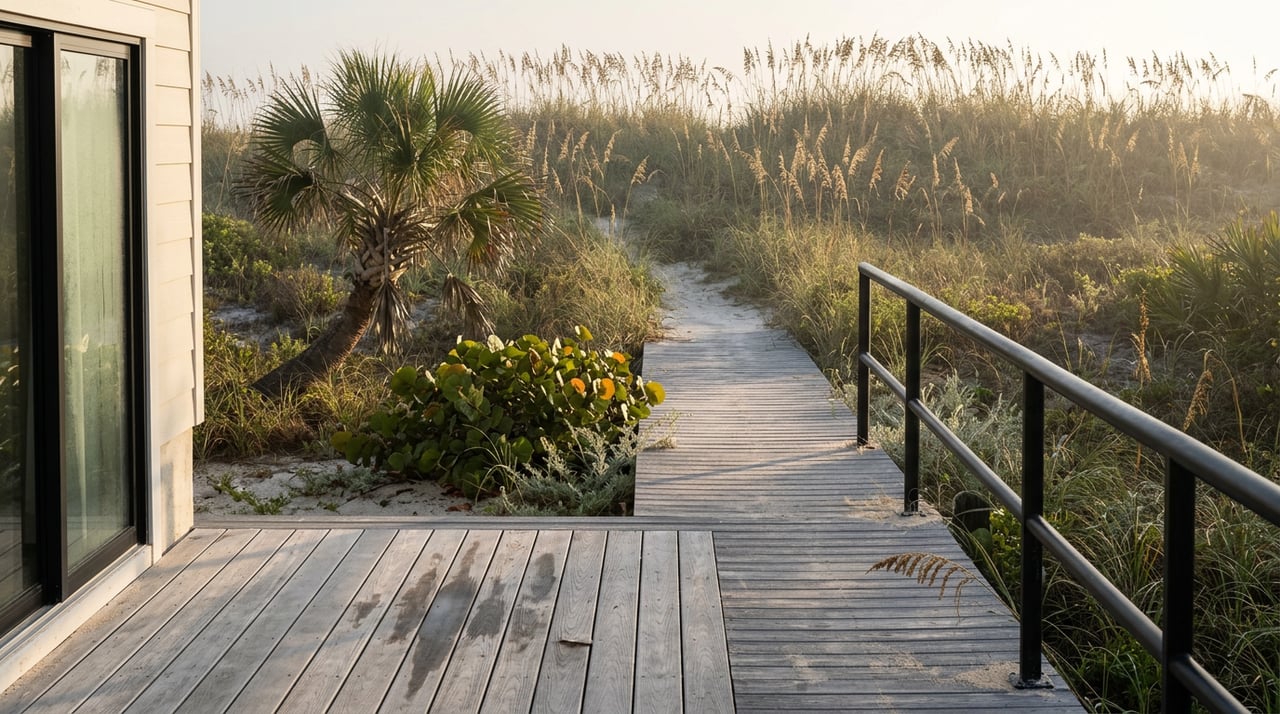
Walk the boardwalk from parking lot one before eight some August morning and you will cross two kinds of evidence before your coffee gets cold. The first is a set of what looks like tractor tracks, a wide, dragging trail running from the waterline up into the dry sand and back again, sometimes ending at a mound staked with orange tape. The second is a tortoise, or the shape of one, tucked into the shade under somebody's bumper in the gravel lot. Neither one comes with an explanation posted nearby. That is the part almost nobody who lives at Barefoot Beach realizes until they go looking for one: the very months when the preserve is doing the most, biologically speaking, are the months when the people paid and trained to explain it are somewhere else.
Sea turtle nesting season here runs from spring through the end of October. Gopher tortoises lay their eggs from May through August. Both are running full tilt right now, in the middle of August, on a beach where the naturalist walks, the ranger-guided canoe trips through the estuary, and the volunteer docents at the Learning Center all operate January through April, the calm season when the water is quiet and most of what you would come to learn about is still asleep in a burrow. The interpretive machine at Barefoot Beach is built for the beach's slow season. Right now, during its loudest one, residents are the only ones left to read the sand.
The turtles are behind pace, and that number needs context
Collier County's Sea Turtle Protection Team staked its first loggerhead nest of 2026 on Barefoot Beach in late April, and daily permitted surveys have run since April 15, with crews patrolling and logging nests and false crawls along all 22.5 miles of Collier County's beachfront every day of the season. A WGCU report on that first nest captured the county's Environmental Supervisor, Mary Toro, laying out the season's ground rules for anyone living beachside.
The most recent count from Toro's team, reported in mid-August, is where the story gets interesting for anyone who actually lives here. Naples, Park Shore, and Marco Island are all running ahead of last year's pace. Barefoot Beach and Vanderbilt Beach are running a little behind. On its own that sounds like bad news for this stretch of coast, but the baseline matters. The 2025 season closed with 1,179 nests across the five beaches the county monitors, the second-best year on record behind 2023's 1,273. A beach can be down slightly against a near-record year and still be having a perfectly normal one. What is actually driving this year's split between beaches is wind, not turtle behavior. Strong westerly winds have been chewing at some stretches of Collier coastline more than others, and the City of Naples beach took the worst of it, losing an estimated 50 nests outright and seeing another 160 inundated. Barefoot and Vanderbilt sit at a different angle to that wind than Naples does, which is a more useful way to think about a soft nest count than treating it as a verdict on the season.
None of that changes what you owe the turtles tonight if you live within sight of the water. Toro's guidance has not moved: lights that illuminate the beach need to be off or shaded by 9 p.m., and any furniture, toys, or gear left on the sand needs to come in by 9:30. A nesting female navigates almost entirely by the contrast between the dark dune line and the lighter horizon over open water, and a porch light left on can be enough to send her back into the Gulf without laying. Flashlights on the beach at night do the same thing to her, and to hatchlings later in the season, which is why rangers ask that you leave the phone flashlight in your pocket if you are walking after dark.
A short list, if you want the practical version:
- Shade or switch off any light that faces the water by 9 p.m.
- Clear chairs, umbrellas, and toys off the sand by 9:30 p.m.
- Skip the flashlight on night walks. Let your eyes adjust instead.
- Never redirect a turtle or a hatchling toward the water. Let her find it herself.
- If you find a nest disturbed or an injured turtle, the Florida Fish and Wildlife Conservation Commission line is (888) 404-3922.
The tortoises are hatching, and the math tells you when
Gopher tortoises get less attention than the turtles because they are here year round instead of showing up for a season, but August is arguably their busiest month too, just underground. Females lay their eggs once a year, typically four to ten of them, in the sandy apron just outside their own burrow, sometime between May and August. Incubation runs roughly ninety days. Do the arithmetic on an egg laid in mid-May and you land on mid-August, which means some of what is emerging from the sand around the preserve's burrows right now are tortoises that have never seen daylight before, each one about an inch and a half to two inches long, occasionally wandering far enough to end up disoriented on the open beach before a ranger nudges them back toward cover.
The species is state-listed as threatened, and Barefoot Beach has one of the denser populations left in Southwest Florida, which makes the last few years worth putting in perspective. Hurricane Ian's storm surge in 2022 is estimated to have drowned or displaced somewhere between 80 and 90 percent of the preserve's gopher tortoises, and sightings stayed rare through the beach's 2023 reopening, when the dunes still carried regrading scars and the mangroves were blackened from the storm. A Gulfshore Life writer visiting the preserve this year counted eight tortoises on a single drive in from the gate, which is the kind of number that only means something against that collapse. It is not a full recovery. It is a population that is visibly building itself back, and doing it in the same summer its newest generation is cracking out of the sand.
If you want a specific place to look, the Friends of Barefoot Beach Preserve keep field notes on individual burrows, including one on the northern boardwalk near the shower area they refer to as Lucy's burrow, where golden creeper grows along the edge, a low native shrub that happens to be one of the plants tortoises eat. It is as close to a marked spot as the preserve offers outside of season. One more thing worth remembering if you drive in: tortoises seek out the shade under parked cars during the hottest part of the day, so a glance underneath before you pull out is a small habit that prevents most of the injuries rangers see.
Nobody official is walking you through it this month
Here is the part that explains why all of the above lands on residents instead of a park brochure. The Friends of Barefoot Beach Preserve, a member-supported nonprofit founded in 1990 after a small group of locals noticed ospreys struggling to build a nest and rigged up a platform to help, runs its weekly naturalist walks and talks January through April. The Learning Center at parking lot one, with its shell collection and volunteer docents, is staffed December through April. The ranger-guided canoe trip through the estuary, a $10, reservation-required outing worth booking if you have never paddled that side of the island, also runs January through April, through the Collier County Parks and Recreation office at 239-252-4060.
That entire calendar sits opposite the wildlife calendar. The organized interpretation happens during the cool season, when snowbirds are in town and the tortoises are least active and sea turtle season has not even opened yet. The stretch running right now, sea turtle nesting from May through October and tortoise hatching concentrated in these very weeks, unfolds without a docent on the boardwalk or a naturalist in the canoe. The Saylor Nature Trail, the mile-and-a-half loop off parking lot three, still has its plant markers with QR codes if you want a self-guided version, and that is genuinely the best resource available between May and December. Otherwise you are reading tractor tracks and burrow aprons the same way the rangers do: by knowing what you are looking at before you get there.
That is really the whole point of a place like Barefoot Beach, the 342-acre stretch of undeveloped barrier island that Collier County bought from the Lely Development Corporation back in 1988 specifically to keep it from becoming another run of Gulf-front condos. It rewards people who already live close enough to notice the small things: a track pattern at dawn, a shell of golden creeper by a named burrow, the particular hush of a beach whose busiest wildlife season happens to be its quietest tourist one. If you are one of the people who gets that, and you are ever curious what your own slice of this coastline is worth or what else is on the market nearby, Luxury by Chad Long is always glad to talk. Request a complimentary home valuation or a private consultation whenever the timing is right.